Wednesday, January 27, 2016

Tuesday, January 26, 2016
Spurs vs. Warriors
Well ... that one got out of hand pretty quickly. On one hand, that's the type of game where the Spurs have to be tempted to just burn the tape and forget it ever happened. They got beat so bad and so convincingly that it's hard to take anything from it other than they need to start over and get back to the basics on both sides of the ball. On the other, that was the first match-up between the two best teams in the league and only one important player (Tim Duncan) on either side was out so anything we can glean from that is important. There's no point in running away from what happened and it's best to look at the data under the light of day and see where the Spurs go from here.

3) More Manu and more Boris and more Kyle Anderson
Playing without Parker and Mills means the Spurs have to look somewhere else for playmaking and the good news is they have multiple 6'6+ players who can handle and pass the ball like guards. Having a bigger player initiate the offense makes it harder for the Warriors to bother them at the point of the attack and get the Spurs out of their flow. Worst comes to worst and all those guys can put Golden State's defenders on their back, bring the ball up the floor and enter the ball in the post. I think you have to go with as big a line-up as possible on the perimeter when you are playing the Warriors.
4) All 6'6+ everything
This might be the line-up I'd try if I were San Antonio: Manu + Green + Simmons + Kawhi + Boris. It's like a slower version of the Warriors Line-up of Death. Or maybe the Line-up of Death in an old Toyota with 100,000 miles on it and a super-changed engine. Boris is probably the one guy in the league who can consistently take Draymond into the post and bury him and they would have pristine spacing to let Boris, Manu or Kawhi initiate the offense. That still leaves room for Kyle Anderson and Rasual Butler - the Spurs have a lot of wing players, which is a really, really good thing.
5) What the hell happened to LaMarcus Aldridge?
Probably the most disappointing storyline for the Spurs had to be the performance of their prized free-agent acquisition. The numbers speak for themselves - 5 points and 3 rebounds on 2-9 shooting - and he might have even been worse on defense. He couldn't guard on the perimeter at all and he didn't provide too much rim protection either. It seemed like Draymond was in his head and he wasn't aggressive when looking for a shot against him and when he was he didn't come up with anything good. Draymond pushed him off his spots and bullied him on both sides of the ball.
6) Draymond Whac-A-Mole
The one positive take-away the Spurs can take from this game is that Draymond is the Warriors best defensive match-up on LaMarcus and Kawhi. I thought LMA did a pretty good job scoring on Andrew Bogut when he was on him and Kawhi did a great job of burying the smaller Warriors wing defenders in the post and then using his size to score over the top of them. That's the way forward for me - whoever Draymond isn't guarding needs to be super aggressive about looking for his own shot. Playing 1-on-1 basketball is the best way to slow down the Golden State defense and prevent them from wreaking havoc, causing turnovers and scoring defense to offense.
7) How much can Tim Duncan help?
While Duncan is their best interior defender of all their big men, the concern is that San Antonio might only be able to play one of their big men at a time anyway. It's very hard for 3-out to beat 5-out and that goes double when your big men can't defend in space or protect the rim. The combo of Boris and David West had trouble doing that and so did any combo with LaMarcus on the floor. Maybe Boris + Tim Duncan presents the best combo of interior defense + perimeter playmaking of any of the Spurs big men duos and that's a look I'd expect the Spurs to go a lot to in a rematch.
8) The Spurs are at a big athletic disadvantage against the Warriors
Just from a pure eye-test perspective that might have been the biggest take-away of the game for me. If you take a step back and try to look at the forest through the trees, it seemed like the Warriors were faster and quicker to every loose ball and they were a step ahead of anything the Spurs were trying to do on either side of the floor. They pressed up on San Antonio on defense and they never let them get comfortable and it seemed like the Spurs never recovered from the initial haymakers that the Warriors threw. That was a 2nd or 3rd round TKO if I ever saw one and San Antonio was mostly on the defensive all night asides from a few stretches in the 2Q. They could have thrown in the towel in the middle of the 3Q and saved everyone the time.
That's why I liked Pop's move to bring in Jonathon Simmons and give him the most run (25 minutes) of any of their bench players. He's their best athlete and he's one of the only guys on their roster who can run and jump with the Warriors. He got stretched a little beyond his capabilities on offense on Monday but he was one of the only guys taking the fight to Golden State. Developing him over the rest of the season went from a luxury to a necessity and they need to fully weaponize him as much as possible to give themselves the best possible chance against the Warriors.
9) The good news is that Pop is willing to think outside the box
When I was taking notes during this game, I assumed I'd have something about playing Kawhi at the 4 and running out line-ups with Manu and Simmons as something the Spurs could try the next time they faced the Warriors. That's how most NBA coaches tend to operate - they are cautious to a fault and they don't want to bust out a lot of line-up changes over the course of a game. Pop's mind is working fast enough that he can process what is happening at real speed and rapidly move on to the next possible combination. He was cycling through line-ups real fast against the Warriors and that's what you want to do in order to try and find something that works.
I'm not a big fan of saving possible adjustments until the playoffs in order to catch teams by surprise because what you really want to know is what adjustments they are going to have to your adjustments and you want to have as much line-up data as possible going into that series in order to figure out your game-plan. The Spurs have a very versatile line-up and Pop is going to try everything over their next 3 game in order to see what works and what doesn't against the Warriors. As Herm Edwards said, you play to win the game.
10) The bad news is the Spurs have to adjust to the Warriors
No battle plan survives first contact with the enemy and it's hard to see how the Spurs can really run out a 2 big-man post-heavy offense against the Warriors and win. Maybe Tim Duncan changes that and I'm being a prisoner of the moment but I liked the point that Ethan Strauss made in a recent podcast on the Cavs vs. Warriors about how sometimes we fall victim to not wanting to over-react and not wanting to hot take what we just saw. I don't see how you can't jump to conclusions based off what we watched on Monday. The way the Warriors are playing some things just aren't going to work against them and there's no point in endlessly trying to pound a square box into a round hole and try to convince yourself otherwise.
The point is that the Warriors can beat the Spurs playing like the Warriors but the Spurs probably can't beat the Warriors playing like the Spurs. They can't afford to stand pat which means they have to make the initial adjustments and move away from their preferred identity on both sides of the ball. Maybe the biggest issue is that they might not be able to catch Golden State for the No. 1 seed anymore, which means a 2nd round match-up with OKC that is going to be tricky, tricky, tricky. Let's not write Spurs vs. Warriors in the WCF in stone just yet and I'm not convinced that they provide the best possible challenge to Golden State anyway.
1) Can they play Tony Parker in this series? Or Patty Mills?
The Warriors put opposing PG's in a box and that was never more evident than what happened on Monday night. If you are asking Tony Parker to guard Steph 1-on-1, you might as well give him a blindfold and a cigarette for all the good that it's going to do. He was never a great defender in his prime and now that he's lost a step he's slower, smaller and less physical than Steph and he can't contest his shot, stay in front of him or chase him around screens. The Warriors didn't even really need to run him in the pick-and-roll with Draymond Green as much as they usually do because he was scoring against Parker so easily. Steph is going to score on anyone but all the more reason not to make it as easy as possible on him.

The problem becomes that you can't really move a small guard off the ball against the Warriors because there's no one to hide him on defense. Golden State has a phalanx of 6'6+ wings who can get their own shot and take a smaller defender into the post. Klay Thompson, Andre Iguodala and Shaun Livingston are going to mercilessly kill someone who can't contest their shot, especially a weaker defender like Parker. The only player that he has a chance of guarding would be Harrison Barnes and that's only out of the hope that he makes a few Harry B type plays that bail out the defender. (He was +1 in a game where every other starter was at least +18 - a lot of that was him playing in garbage time but still).
My guess is that even Barnes would make short work of Parker and Mills which means that the only player in the Warriors rotation that those two can even hope to guard is Leandro Barbosa. And I'd assume that Kerr would take him out of the rotation when things got serious. You don't want to over-react to one game and there are a lot of possible adjustments that Pop could make but I don't see what he could do to keep his PG's on the floor against the Warriors. Not with Steph playing the way he is playing and with the size and speed advantage the rest of their wings would have against 6'1 guys who aren't good defenders to begin with. It becomes a game of Whac-A-Mole and every time Parker and Mills get on to the floor they are going to get whacked and they are going to get whacked hard.
2) Kawhi on Curry
Everyone wants to talk about the brutal off-ball cut that Curry put on Kawhi and the couple of baskets he was able to score against the best defender in the league.
So Steph just did this to probably the best defensive player in the league.. https://t.co/o3wBsbAJuV
— Nick Medina (@rapfavnick) January 26, 2016
That was bad but I still think Kawhi gives them the best chance of sticking Curry 1-on-1 and you want to even out those odds as much as possible (even if it still leaves you at a disadvantage) to give you as much of a chance to make it up at the other spots on the floor. The margin for error that Steph is playing with at the moment is so high that you have to do whatever possible to slow him down, especially if you can do it with only one player. That means Kawhi, Danny Green and Jonathan Simmons taking turns on him on defense and those guys running through a ton of screens on the other end of the floor to try and take his legs out from under him. You want to physically tax him as much as possible, which is another reason why the Spurs have to take the PG's off the floor.
3) More Manu and more Boris and more Kyle Anderson
Playing without Parker and Mills means the Spurs have to look somewhere else for playmaking and the good news is they have multiple 6'6+ players who can handle and pass the ball like guards. Having a bigger player initiate the offense makes it harder for the Warriors to bother them at the point of the attack and get the Spurs out of their flow. Worst comes to worst and all those guys can put Golden State's defenders on their back, bring the ball up the floor and enter the ball in the post. I think you have to go with as big a line-up as possible on the perimeter when you are playing the Warriors.
4) All 6'6+ everything
This might be the line-up I'd try if I were San Antonio: Manu + Green + Simmons + Kawhi + Boris. It's like a slower version of the Warriors Line-up of Death. Or maybe the Line-up of Death in an old Toyota with 100,000 miles on it and a super-changed engine. Boris is probably the one guy in the league who can consistently take Draymond into the post and bury him and they would have pristine spacing to let Boris, Manu or Kawhi initiate the offense. That still leaves room for Kyle Anderson and Rasual Butler - the Spurs have a lot of wing players, which is a really, really good thing.
5) What the hell happened to LaMarcus Aldridge?
Probably the most disappointing storyline for the Spurs had to be the performance of their prized free-agent acquisition. The numbers speak for themselves - 5 points and 3 rebounds on 2-9 shooting - and he might have even been worse on defense. He couldn't guard on the perimeter at all and he didn't provide too much rim protection either. It seemed like Draymond was in his head and he wasn't aggressive when looking for a shot against him and when he was he didn't come up with anything good. Draymond pushed him off his spots and bullied him on both sides of the ball.
Draymond Green +29 (game high)
LaMarcus Aldridge -20 (game low)
— Marcus Thompson (@ThompsonScribe) January 26, 2016
In theory, LaMarcus has the perfect skill-set to attack a shorter post defender like Draymond. If he can get comfortable and bury 18-foot turn-arounds in the post there shouldn't be much a smaller player with a shorter wingspan can do to stop him. What I did like in the 2nd half was when LaMarcus started using pump fakes to get Draymond off him and get him in the air in order to draw contact and go to the line. The Spurs gave him $80 million dollars because he's one of the best 1-on-1 scorers in the league and he's going to have to figure out some way of at least making Draymond uncomfortable on defense if they are going to have a chance.6) Draymond Whac-A-Mole
The one positive take-away the Spurs can take from this game is that Draymond is the Warriors best defensive match-up on LaMarcus and Kawhi. I thought LMA did a pretty good job scoring on Andrew Bogut when he was on him and Kawhi did a great job of burying the smaller Warriors wing defenders in the post and then using his size to score over the top of them. That's the way forward for me - whoever Draymond isn't guarding needs to be super aggressive about looking for his own shot. Playing 1-on-1 basketball is the best way to slow down the Golden State defense and prevent them from wreaking havoc, causing turnovers and scoring defense to offense.
7) How much can Tim Duncan help?
While Duncan is their best interior defender of all their big men, the concern is that San Antonio might only be able to play one of their big men at a time anyway. It's very hard for 3-out to beat 5-out and that goes double when your big men can't defend in space or protect the rim. The combo of Boris and David West had trouble doing that and so did any combo with LaMarcus on the floor. Maybe Boris + Tim Duncan presents the best combo of interior defense + perimeter playmaking of any of the Spurs big men duos and that's a look I'd expect the Spurs to go a lot to in a rematch.
8) The Spurs are at a big athletic disadvantage against the Warriors
Just from a pure eye-test perspective that might have been the biggest take-away of the game for me. If you take a step back and try to look at the forest through the trees, it seemed like the Warriors were faster and quicker to every loose ball and they were a step ahead of anything the Spurs were trying to do on either side of the floor. They pressed up on San Antonio on defense and they never let them get comfortable and it seemed like the Spurs never recovered from the initial haymakers that the Warriors threw. That was a 2nd or 3rd round TKO if I ever saw one and San Antonio was mostly on the defensive all night asides from a few stretches in the 2Q. They could have thrown in the towel in the middle of the 3Q and saved everyone the time.
That's why I liked Pop's move to bring in Jonathon Simmons and give him the most run (25 minutes) of any of their bench players. He's their best athlete and he's one of the only guys on their roster who can run and jump with the Warriors. He got stretched a little beyond his capabilities on offense on Monday but he was one of the only guys taking the fight to Golden State. Developing him over the rest of the season went from a luxury to a necessity and they need to fully weaponize him as much as possible to give themselves the best possible chance against the Warriors.
9) The good news is that Pop is willing to think outside the box
When I was taking notes during this game, I assumed I'd have something about playing Kawhi at the 4 and running out line-ups with Manu and Simmons as something the Spurs could try the next time they faced the Warriors. That's how most NBA coaches tend to operate - they are cautious to a fault and they don't want to bust out a lot of line-up changes over the course of a game. Pop's mind is working fast enough that he can process what is happening at real speed and rapidly move on to the next possible combination. He was cycling through line-ups real fast against the Warriors and that's what you want to do in order to try and find something that works.
I'm not a big fan of saving possible adjustments until the playoffs in order to catch teams by surprise because what you really want to know is what adjustments they are going to have to your adjustments and you want to have as much line-up data as possible going into that series in order to figure out your game-plan. The Spurs have a very versatile line-up and Pop is going to try everything over their next 3 game in order to see what works and what doesn't against the Warriors. As Herm Edwards said, you play to win the game.
10) The bad news is the Spurs have to adjust to the Warriors
No battle plan survives first contact with the enemy and it's hard to see how the Spurs can really run out a 2 big-man post-heavy offense against the Warriors and win. Maybe Tim Duncan changes that and I'm being a prisoner of the moment but I liked the point that Ethan Strauss made in a recent podcast on the Cavs vs. Warriors about how sometimes we fall victim to not wanting to over-react and not wanting to hot take what we just saw. I don't see how you can't jump to conclusions based off what we watched on Monday. The way the Warriors are playing some things just aren't going to work against them and there's no point in endlessly trying to pound a square box into a round hole and try to convince yourself otherwise.
The point is that the Warriors can beat the Spurs playing like the Warriors but the Spurs probably can't beat the Warriors playing like the Spurs. They can't afford to stand pat which means they have to make the initial adjustments and move away from their preferred identity on both sides of the ball. Maybe the biggest issue is that they might not be able to catch Golden State for the No. 1 seed anymore, which means a 2nd round match-up with OKC that is going to be tricky, tricky, tricky. Let's not write Spurs vs. Warriors in the WCF in stone just yet and I'm not convinced that they provide the best possible challenge to Golden State anyway.
Monday, January 25, 2016
Brice Johnson
There have been few big men in the country more productive than Brice Johnson, whose made the leap from good to great in his senior season at UNC. With Marcus Paige being very inconsistent and Kennedy Meeks struggling with injuries, Johnson has been the best player on the No. 1 team in the country. He has improved in almost every single statistical category and he is putting up first-team All-American type numbers:
Junior: 12.9 points, 7.8 rebounds, 0.9 assists, 0.7 steals and 0.7 blocks on 56.6%
Senior: 16.8 points, 10.2 rebounds, 1.4 assists, 1.3 steals and 1.3 blocks on 63.3%
Johnson came into Chapel Hill as a super-skinny big man and has steadily put weight on his frame over the last four years. He was always faster and more athletic than most of his competition at the NCAA level and now he's stronger than them too. At 6'9 230 with a 6'11 wingspan, he's undersized for the C position at the NBA level and he doesn't have great length for either front-court position, but he has the type of nuclear athleticism that can make up for it.
Johnson is a monster on the glass
Johnson has po-go sticks for legs and he can jump 2 or 3 times before a lot of big man can jump once. The result is a guy whose a terror on the offensive boards. He would be amazing at 21 because he could always tip everyone else back to zero:

He gets a lot of his points from being a garbage man around the rim. He's a relentless rebounder with a nose for the ball, great hands and a soft touch in the lane. He can also elevate over the top of just about anyone, which allows him to score in traffic:
Where he has really improved this season is on the defensive glass, boosting his defensive rebound percentage from 22.7 to 31.1. That's where the extra strength comes into play, as Johnson has an easier time keeping guys on his back and from there he's going to win most jumping contests:

Johnson has improved as a shooter
He's probably never going to be a 3-point shooter, but he is more capable of stepping out and knocking down a mid-range jumper, which is a must for a big man at almost any level of the game these days. Johnson's ability to play out at 15+ feet makes it much easier for UNC to play him with a more traditional 5 like Kennedy Meeks:

He even has the beginnings of a face-up game. If he can force big men to respect his J, he's so fast that he should be able to get around them pretty easily:

Free-thow percentage is one quick and easy way to look the isolated shooting stroke of a big man. That tells you how much time he has put in improving his game and whether he can play some pick-and-pop at the next level. Maybe the most encouraging thing about projecting Johnson to the NBA is how much he has improved in that category in his time at UNC.
Freshman: 57.7% on 0.7 FTA's
Sophomore: 62.2% on 2.4 FTA's
Junior: 67.8% on 3.0 FTA's
Senior: 79.5% on 4.4 FTA's
Johnson is a solid interior defender but his lack of elite size and length is a problem
Johnson averages 1.3 blocks a game, which is pretty good for a guy who plays a lot of PF. He has good timing and good defensive instincts in terms of rotating over and protecting the rim:


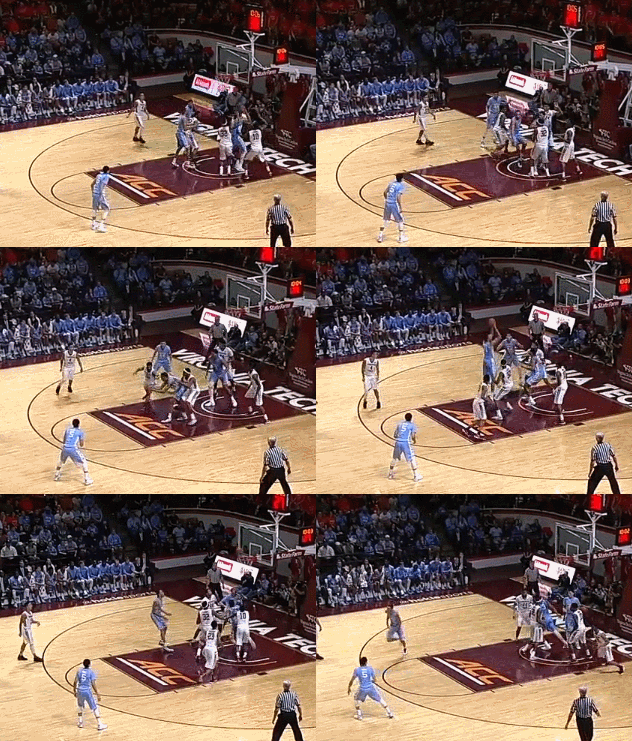
There were a couple of plays in their 75-70 victory over VA Tech that show why it's difficult to project him as a full-time 5 at the next level. In this sequence, Johnson isn't strong enough to prevent freshman big man Kerry Blackshear Jr. (6'10 240) from powering through him and finishing.

In this one, Blackshear is able to score right over the top of Johnson when he dives to the rim. He's just giving up too much size to bigger players (and he doesn't have the super-sized arms like Draymond Green to make up for it) to be any more than a situational player at the C position in the NBA:

Johnson struggles to guard 1-on-1 on the perimeter
The interesting part of the Virginia Tech game for Johnson was his match-up with Zach LeDay, a 6'7 235 combo forward whom Buzz Williams has slid down to the small-ball 4 position. LeDay is big enough to at least hold his own in the post and he can shoot the 3 and put the ball on the floor, which makes him the perfect test case to see how Johnson could fare against small-ball 4's at the next level. The results were mixed, especially on the defensive end. Johnson is not comfortable closing out around a smaller wing player at the 3-point line and he repeatedly let LeDay (whose been one of the breakout stars of ACC play this season) get right around him:

Johnson didn't really want to get out on LeDay and LeDay was able to punish him for closing out short:

Given the way the league is going, it's hard to imagine Johnson as a full-time starter at the 4 position. He doesn't have the range to stretch the floor out to the 3-point line and he's not comfortable guarding 3/4 types like Harrison Barnes. He's not a great back-to-the-basket scorer and even if he was trying to win with size at the 4 position has proven to be a losing cause over the last few seasons.
The most intriguing part of Johnson's game is his pick-and-roll D
While he's not great on 1-on-1 defense at either front-court position, Johnson's speed and athleticism makes him an intriguing option when it comes to playing team defense in the NBA, particularly on the pick-and-roll. His steal average (1.3 a game) is really impressive for a big man and it shows that he has quick feet and quick hands, which is exactly what you want when a big is defending in the two-man game. Here he is trapping and forcing a TO:

He's fast enough to play a step off guards and still contest their shot coming off the screen:

He's also capable of sliding his feet and staying in front of smaller guards when they drive the ball at him on the switch:

Brice Johnson could be the next Brandan Wright
Put it all together and Johnson is an intriguing prospect with very defined strengths and weaknesses who will have to be put in the right situation in order to succeed at the next level. He's not big enough to be a starting 5 and he's not perimeter oriented enough to be a starting 4 but he's a great athlete and a great rebounder who can be a good contributor in the pick-and-roll game at both sides of the ball. The role he should have is as a small-ball 5 in a 4-out offense, ala what fellow UNC big man Brandan Wright was doing when playing with Dirk Nowitzki in Dallas.
If he's playing in enough space, Johnson can has the speed, the touch and the leaping ability to be a huge problem as a roll man. He can also knock down free throws, which is a huge plus for a big man whose going to catch the ball around the rim a lot. While you didn't see it in these clips, he has crazy dunking ability and he's going to put guys on some Vines when he gets to the NBA.
He has also greatly improved as a passer in his time at the NCAA level. Watch him dissect the Syracuse zone in these clips, a good indication of the improved skill level and feel for the game he has developed under Roy Williams:
On the other side of the ball, the key with Johnson is using him in the right match-ups. You don't want him banging against guys like Andre Drummond and DeMarcus Cousins but he's strong and athletic enough to deal with most backup 5's in the modern NBA.
It's going to be a lot like what happened with Wright. If you put him somewhere where he has to play with another traditional big men in a post-heavy offense where he doesn't get to operate in a lot of space, he's not going to be all that effective. If you let him play in a super uptempo offense like UNC and let him play in space in the half-court, he could be a real problem. DraftExpress currently has him at the No. 42 pick in their most recent mock draft, which seems a little low for him, but it makes sense when you consider that he can only really succeed in one role at the next level - small-ball 5 in a spread pick-and-roll offense.
Junior: 12.9 points, 7.8 rebounds, 0.9 assists, 0.7 steals and 0.7 blocks on 56.6%
Senior: 16.8 points, 10.2 rebounds, 1.4 assists, 1.3 steals and 1.3 blocks on 63.3%
Johnson came into Chapel Hill as a super-skinny big man and has steadily put weight on his frame over the last four years. He was always faster and more athletic than most of his competition at the NCAA level and now he's stronger than them too. At 6'9 230 with a 6'11 wingspan, he's undersized for the C position at the NBA level and he doesn't have great length for either front-court position, but he has the type of nuclear athleticism that can make up for it.
Johnson is a monster on the glass
Johnson has po-go sticks for legs and he can jump 2 or 3 times before a lot of big man can jump once. The result is a guy whose a terror on the offensive boards. He would be amazing at 21 because he could always tip everyone else back to zero:
He gets a lot of his points from being a garbage man around the rim. He's a relentless rebounder with a nose for the ball, great hands and a soft touch in the lane. He can also elevate over the top of just about anyone, which allows him to score in traffic:
Where he has really improved this season is on the defensive glass, boosting his defensive rebound percentage from 22.7 to 31.1. That's where the extra strength comes into play, as Johnson has an easier time keeping guys on his back and from there he's going to win most jumping contests:
Johnson has improved as a shooter
He's probably never going to be a 3-point shooter, but he is more capable of stepping out and knocking down a mid-range jumper, which is a must for a big man at almost any level of the game these days. Johnson's ability to play out at 15+ feet makes it much easier for UNC to play him with a more traditional 5 like Kennedy Meeks:

He even has the beginnings of a face-up game. If he can force big men to respect his J, he's so fast that he should be able to get around them pretty easily:

Free-thow percentage is one quick and easy way to look the isolated shooting stroke of a big man. That tells you how much time he has put in improving his game and whether he can play some pick-and-pop at the next level. Maybe the most encouraging thing about projecting Johnson to the NBA is how much he has improved in that category in his time at UNC.
Freshman: 57.7% on 0.7 FTA's
Sophomore: 62.2% on 2.4 FTA's
Junior: 67.8% on 3.0 FTA's
Senior: 79.5% on 4.4 FTA's
Johnson is a solid interior defender but his lack of elite size and length is a problem
Johnson averages 1.3 blocks a game, which is pretty good for a guy who plays a lot of PF. He has good timing and good defensive instincts in terms of rotating over and protecting the rim:

He does a good job of being active and using his ability to play above the rim to bother opponents shots. The problem is that his lack of elite length (6'11 wingspan) means he has to get off his feet to be a good interior defender, which leaves him vulnerable to pump fakes and foul trouble:

There were a couple of plays in their 75-70 victory over VA Tech that show why it's difficult to project him as a full-time 5 at the next level. In this sequence, Johnson isn't strong enough to prevent freshman big man Kerry Blackshear Jr. (6'10 240) from powering through him and finishing.
In this one, Blackshear is able to score right over the top of Johnson when he dives to the rim. He's just giving up too much size to bigger players (and he doesn't have the super-sized arms like Draymond Green to make up for it) to be any more than a situational player at the C position in the NBA:

Johnson struggles to guard 1-on-1 on the perimeter
The interesting part of the Virginia Tech game for Johnson was his match-up with Zach LeDay, a 6'7 235 combo forward whom Buzz Williams has slid down to the small-ball 4 position. LeDay is big enough to at least hold his own in the post and he can shoot the 3 and put the ball on the floor, which makes him the perfect test case to see how Johnson could fare against small-ball 4's at the next level. The results were mixed, especially on the defensive end. Johnson is not comfortable closing out around a smaller wing player at the 3-point line and he repeatedly let LeDay (whose been one of the breakout stars of ACC play this season) get right around him:

Johnson didn't really want to get out on LeDay and LeDay was able to punish him for closing out short:
Given the way the league is going, it's hard to imagine Johnson as a full-time starter at the 4 position. He doesn't have the range to stretch the floor out to the 3-point line and he's not comfortable guarding 3/4 types like Harrison Barnes. He's not a great back-to-the-basket scorer and even if he was trying to win with size at the 4 position has proven to be a losing cause over the last few seasons.
The most intriguing part of Johnson's game is his pick-and-roll D
While he's not great on 1-on-1 defense at either front-court position, Johnson's speed and athleticism makes him an intriguing option when it comes to playing team defense in the NBA, particularly on the pick-and-roll. His steal average (1.3 a game) is really impressive for a big man and it shows that he has quick feet and quick hands, which is exactly what you want when a big is defending in the two-man game. Here he is trapping and forcing a TO:

He's fast enough to play a step off guards and still contest their shot coming off the screen:
He's also capable of sliding his feet and staying in front of smaller guards when they drive the ball at him on the switch:

Brice Johnson could be the next Brandan Wright
Put it all together and Johnson is an intriguing prospect with very defined strengths and weaknesses who will have to be put in the right situation in order to succeed at the next level. He's not big enough to be a starting 5 and he's not perimeter oriented enough to be a starting 4 but he's a great athlete and a great rebounder who can be a good contributor in the pick-and-roll game at both sides of the ball. The role he should have is as a small-ball 5 in a 4-out offense, ala what fellow UNC big man Brandan Wright was doing when playing with Dirk Nowitzki in Dallas.
If he's playing in enough space, Johnson can has the speed, the touch and the leaping ability to be a huge problem as a roll man. He can also knock down free throws, which is a huge plus for a big man whose going to catch the ball around the rim a lot. While you didn't see it in these clips, he has crazy dunking ability and he's going to put guys on some Vines when he gets to the NBA.
He has also greatly improved as a passer in his time at the NCAA level. Watch him dissect the Syracuse zone in these clips, a good indication of the improved skill level and feel for the game he has developed under Roy Williams:
On the other side of the ball, the key with Johnson is using him in the right match-ups. You don't want him banging against guys like Andre Drummond and DeMarcus Cousins but he's strong and athletic enough to deal with most backup 5's in the modern NBA.
It's going to be a lot like what happened with Wright. If you put him somewhere where he has to play with another traditional big men in a post-heavy offense where he doesn't get to operate in a lot of space, he's not going to be all that effective. If you let him play in a super uptempo offense like UNC and let him play in space in the half-court, he could be a real problem. DraftExpress currently has him at the No. 42 pick in their most recent mock draft, which seems a little low for him, but it makes sense when you consider that he can only really succeed in one role at the next level - small-ball 5 in a spread pick-and-roll offense.
OKC Supporting Cast
At RealGM, a look at the possible options the Thunder can use next to their Big Three.
Saturday, January 23, 2016
Baylor vs. OU
1) You really can't zone a team like OU
Baylor was drawing dead from the start in this one. If you were drawing up a blueprint for a team that would kill the zone, it would look a lot like OU. They are a well-coached and very experienced team with three guards who can fill it up from the perimeter and a big man who can knock down mid-range jumpers and make plays from the middle of the zone. When Baylor eventually went to man when they were down by 15+ points in the middle of the 2nd half, OU was shooting 65.7% from the field and 66.7% from 3. They have too many good decision-makers to make a lot of mistakes against the zone and they have too many good shooters that they are going to kill you if you keep giving them open looks.
Baylor couldn't even take advantage of Buddy Hield getting in foul trouble in the first half because OU knew they could just run offense and create shots in the half-court against the zone. Scott Drew has had a ton of success in his time in Waco and it's hard to knock him for what he has done to build up the program but I feel pretty comfortable making the prediction that they will never win a Big 12 championship until he moves away from his beloved 1-3-1 zone. It does have its benefits in the NCAA Tournament because teams are so unfamiliar with the style of play and the overall length and athleticism that Baylor can throw at them, but every team in the Big 12 knows precisely how to attack it and there's a real ceiling on this program until he decides to take advantage of the pronounced athletic advantage he has on most nights and commit to playing man defense.
2) OU doesn't have the horses to be the No. 1 team in the country
This is going to sound like hating after the performance they pulled off on Saturday - a dominant 82-72 win at Baylor that gave them their first home loss of the season - but I thought you could see some of the flaws on OU's roster nevertheless. They are a good team and it's easy to see why they have been so successful this season - they start three seniors and one junior and they are built around 3 guards who can shoot, dribble and pass, one of whom is one of the best players in the country. That's the formula for racking up a lot of wins at the NCAA level and for putting up the type of gaudy offensive numbers that make everyone sit up and notice. It has been enough to get them to No. 1 in a year where there aren't many great teams, but they aren't going to stay there after losing to Iowa State earlier in the week and I doubt they return.
There are three main problems that I can see with this team:
1) They aren't very deep.
They only play 7 guys serious minutes and the two guys that come off the bench - freshman forward Dante Buford and senior guard Dinjiyl Walker - are basically just placeholders there to give the starters some rest. Not only are they very vulnerable to injury, but any amount of foul trouble could be their doom in an NCAA Tournament game. A ref with a tight whistle could absolutely kill them because anyone picking up 2 early fouls will have to be play super cautious to avoid exposing their lack of depth.
2) They don't have a lot of size upfront.
Ryan Spangler (6'8 235) is a really solid role-playing big man and Khadeem Lattin (6'9 210) has a good combination of length and athleticism but they aren't all that big and they can't impose their will on the game. That's a problem two ways - 1) they will be giving up a lot of size to bigger teams (see Baylor beating them 34 to 19 on the boards) and 2) they can't force smaller teams to adjust to them. You can't pound the ball into Lattin and Spangler and they aren't going to kill you as shot-creators or 1-on-1 players. Spangler can spread the floor and Lattin can protect the rim but they are there to hold serve and not to win the game.
3) They don't have a lot of size on the wings
Taurean Prince (6'7 220) wasn't totally able to take advantage of this on Saturday for reasons I will get into later but OU doesn't have a natural option to match-up with bigger 3/4 combo forwards. Lattin is a more of a traditional big man + rim protector type, reserve big man Dante Buford isn't a great athlete while Buddy Hield is their biggest guard and he has to save himself for the offensive end of the floor. The last thing they want is for Hield to pick up cheap fouls banging with bigger players, which is what happened on Saturday. Their best perimeter defender is Isaiah Cousins and he's only 6'4 200.
3) Buddy Hield as a pro prospect
It was hard to get a great feel for Hield in this game because Baylor spent so much of it on zone on one end and doesn't run a ton of offense through their perimeter players on the other. He put up 19 points in 10 shots by going 4-7 from 3 mostly by shooting over the top of the Baylor zone and getting out in transition and knocking down open 3's. He did a decent job on defense, as he slid between all 3 of the Baylor perimeter players and didn't let the bigger Prince or the smaller and faster Medford take advantage of him. It was a solid all-around performance that showcased the strengths of his game and couldn't tell us too much about his weaknesses.
The thing about Hield's game that you have to like is that he's a volume 3-point shooter (8.0 3PA on 51.5% as a senior) whose big and athletic to defend his position and can put the ball on the floor and move the ball. He should have a pretty solid floor as an NBA player as a plus shooter who doesn't kill you on the other end of the floor and isn't a liability with the ball in his hands. The question is his ceiling - will he be able to create his own shot against bigger and more athletic defenders? Will he be able to match up with those players on defense? That's what separates starting 2's from backup 2's at the next level and Hield doesn't offer a ton of versatility to your line-up if he's coming off the bench. Let's remember that he's an older player playing in great space who has a ton of offense run through him at the NCAA level. He has everything set up to be a star at the NCAA level and that may not necessarily translate to the NBA.
I'd really like to see what he can do in a 1-on-1 match-up against one of the other top wing prospects in this year's draft. Unfortunately, none of them play in the Big 12. While Hield was able to get the best of Wayne Selden in their first game against Kansas, he struggled at times against the smaller and faster Frank Mason. I'll be really interested to see whom they face in the NCAA Tournament and I'd love to see what he could do if matched up against someone like Caris Levert or bigger PG's like Kris Dunn or Wade Baldwin IV.
4) Isaiah Cousins was the difference maker on defense
Cousins doesn't get a lot of publicity playing in the shadow of Hield, but he's a very good player in his own right and he's OU's best two-way player on the perimeter. He had 13 points, 9 assists and 2 steals on 6 shots against Baylor and his ability to press up on the Baylor guards and use his long arms and quick hands to generate turnovers was key for OU to get in control of the game at the end of the first half, when Hield was in foul trouble. He got them a lot of points going defense to offense and he was able to keep Lester Medford in check, as Baylor's lead guard finished with only 6 points on 6 shots and 7 assists on 6 turnovers. Cousins is a great complement to Hield on both sides of the ball and his ability to take the tougher defensive assignment on the perimeter, control the tempo of the game and create easy shots for his running buddy is a big reason why Hield is having the type of season that he's having. They have a real Batman and Robin set-up between their two senior guards and it's the biggest strength of this OU team.
5) Taurean Prince at the 4
Scott Drew almost has too much of a good thing with his frontcourt rotation following the emergence of Terry Maston as a solid contributor at the 4 position. He has three really good NCAA big men - Gathers, Motley and Maston - but his best player (Prince) is most effective as a small-ball 4. When Prince is playing at the 3, he tends to settle for jumpers and there isn't a lot of room for him to leverage his size and athleticism and attack the rim since none of the Baylor big men can stretch out the defense. While Baylor was able to pound OU on the glass with their bigger line-ups, they found their most success when they were spreading the floor with Prince. Moving Prince down a position also had the benefit of scrambling the match-ups for OU. Since they didn't want either of their big men guarding him, it forced Spangler to chase one of the Baylor guards on the perimeter.
6) King McClure
The only way to fully take advantage of playing small is having enough wing players who can take advantage of all that extra space upfront. The guy I'm really interested in for Baylor who could possibly fill that role is freshman guard King McClure, who had one of the best games of his young career on Saturday, with 11 points and 4 steals on 6 shots. At 6'3 200, he has a good combination of size and speed for a college guard and he has the ability to shoot and dribble the ball. He was a 4-star recruit who was chased by a ton of top schools so there's definitely the possibility that there's more to his game than the 4 PPG he has averaged this season. Baylor needs more shot-making from their perimeter and McClure is one guy who could possibly provide that for them as the season goes on.
7) How far can OU go in the Tourney?
As we saw in this one, you really can't zone OU so a team that can't hang with them athletically on the perimeter is going to be in trouble. Spangler can spread the floor, Lattin can roll to the rim and all 3 of their guards can initiate offense - they play a modern offense and they won't have trouble scoring points on just about any team in the country. That should be enough to get them into the 2nd weekend of the Tourney, though I do think they have a few weak spots that could be exploited by a really good mid-major team - they can't dominate a smaller team with size (which means there are a lot more potential teams who could give them trouble) and they are so vulnerable to foul trouble.
The real concern is going to be in the 2nd weekend when they have to face bigger and deeper front-lines who can get Spangler and Lattin into foul trouble because they have almost nothing behind them. Teams that can get to the rim, either at the 4 or 5 positions or with bigger wings who can attack off the dribble, can play inside-out and take advantage of their defense. If they get a perfect draw, they could make it all the way to the Final 4 but my guess is their lack of size across the board and their lack of a pure 5 and a pure 3 is going to be their undoing at some point in their Tourney and it could be a lot earlier than many people expect given their national ranking.
Friday, January 22, 2016
Mavs vs. Thunder
1) It's Salah Mejri's world and we are all just living in it
This game was just about over until Rick Carlisle reached all the way to the very bottom of his bag of tricks and wound up with Salah Mejri, the 29-year old third string C from Tunisia who had played a grand total of 45 minutes in the NBA coming into Friday. Mejri is apparently an OKC killer because he had a great showing against the Thunder - 17 points, 9 rebounds and 8 shots - when the Mavs rested all of their guys last week.
There's a lot to like about his game. At 7'2 245 with a 7'3 wingspan, he has the length and athleticism to protect the rim and be a threat as the roll man. He's a less explosive version of Javale McGee who is A) in better shape B) doesn't make as many mental mistakes C) makes free throws and D) has less baggage in terms of his reputation. The Mavs wouldn't have had a chance without Mejri's presence at the rim on both sides of the ball in the 4Q - he finished with 5 points, 1 rebound and 2 blocks in 8 minutes and he was tied for the best plus/minus on the team (+8). How's this for a storyline? Mejri had monstrous blocks on Kevin Durant and Russell Westbrook in crunch time that fueled the Mavs aborted comeback.
You don't want to get too excited about him considering how small the sample size is. No one in the league knows anything about him (although he claims that Durant and Westbrook knew who he was because he blocked their shots in international play) and there's isn't really a scouting report on him at the moment so it's easy for him to surprise teams who don't have a game-plan for attacking him. Nevertheless, he's been very productive when he has gotten on the floor and the idea of Salah Mejri is certainly very enticing to this team. He could theoretically give you the best of both worlds at the C position - more of an offensive threat than Zaza, more defensive awareness than McGee. He's definitely going to need some minutes, if for no other reason than for the Mavs to figure out exactly what they have in this 7'2 international man of mystery.
What worries me is that Mejri's minutes will probably come out of JaVale's and while he still makes a lot of mistakes when he's out there I don't think there's any question that JaVale has been a positive presence for this team. JaVale had 11 points and 4 rebounds in 14 minutes tonight and he had several monstrous pick-and-roll finishes that got the whole building excited. For as much as Zaza has given the team this season, I'd much rather play McGee and Mejri more minutes and become a pure spread pick-and-roll team and use Zaza as a change of pace rebounder/enforcer because that's the best way to maximize everyone else's game on both sides of the ball.
2) Talent beats execution
Before the Mejri Magic Hour began, the story of this game was the way OKC put their foot on the pedal in the 3Q and blew the Mavs out of the water. Dallas had played one of their better halves of the season in the first half and they were out-executing the Thunder to death. I guess they really missed the presence of Steven Adams (who hurt himself in warm-ups) at the rim because they gave up a number of open lay-ups and they had a terrible time communicating and setting up the second line of their defense. I'm not sure how many open shots they gave up on back-door cuts but it was a lot.
That was all well and good but then the 3Q began and OKC was like we have Westbrook, Durant and Ibaka and y'all don't. The Thunder stars just absolutely took over the game and there was really nothing the Mavs could do about it. Westbrook started making dead sprints to the front of the rim off Mavs misses and creating wide open looks for either himself or one of his teammates. Carlisle was moving Wes Matthews between Durant and Westbrook all game to stem the bleeding and whoever he wasn't guarding pretty much had free reign out there. The best teams in the league have to have 2 perimeter stoppers and the Mavs only have one. It's not the biggest problem this team has but it is a big problem in a game like this one.
3) Durant and Westbrook as passers
If the Mavs had a defensive strategy against the Thunder stars that wasn't close your eyes and pray, it was sending a bunch of extra men at them in order to make them pass the ball. If the mark of a well-coached team is that the right guys are shooting the ball, the Thunder weren't particularly well-coached - they took 91 shots and Durant and Westbrook only had 40 and most teams who play them will live with that. None of that is to say that they should have forced the action more - they both made the right pass most of the night (Westbrook still took his share of silly shots of course) and they combined for 14 assists on 7 turnovers. OKC's supporting cast is going to have to knock down shots and they did a good enough job on Friday to pull out the win.
4) The emergence of Cam Payne
From a plus/minus standpoint, the most productive player for OKC was rookie Cam Payne, who is slowly moving into Killa Cam territory. He was +13 in 12 minutes and had 8 points (on 10 shots) and 3 assists (on 2 turnovers). Payne appears to be another keeper from the Thunder scouting department, the one part of their organization that always seems to pull their weight. More important than his individual numbers was the way he controlled the game, ran the pick-and-roll and created good shots for the OKC 2nd when neither Westbrook nor Durant was in. I'm pretty sure the Thunder would still be better off staggering their minutes but if Payne can hold the fort it at least gives them a chance.
At 6'2 180, Payne is never going to wow you physically and his ridiculous haircut only makes him easier to underestimate. He's pretty frail-looking in person, he doesn't have a lot of meat on his bones and he's not a plus athlete but he's a really smart player who knows how to maximize his physical abilities and he doesn't appear to make a lot of the mental mistakes that get rookie PG's sent to the bench. Like most OKC draft picks, he has really long arms (6'7 wingspan) and that helps his cause. He can shoot off the dribble from the 3-point line and he already has a nice floater as well as a great feel for manipulating the defense and finding the open man on the move. He's a player - there's no doubt about that. The question is whether he can survive enough on D that OKC can use him more as the season goes on.
"He was huge. They trapped him out there at half court, which I sort of take as a compliment," said Durant. "If they trap you that mean you're doing something right, so he came out and played well. He is playing with a lot of confidence right now and we are going to need that coming down the line."
5) The Thunder have their closing 5
OKC went with Westbrook - Waiters - Singler - KD - Ibaka tonight and that's the group that I assume they're going to use going forward. Singler has apparently returned from the dead and remembered how to play basketball so that 5-man unit is their best approximation of a group that can play D and stretch the floor around their Big 3. Going with KD at the 4 and Ibaka at the 5 puts the defense in an impossible position and Donovan clearly trusts Waiters over DJ Augustin (too short), Anthony Morrow (can't defend) and Andre Roberson (can't shoot). I wonder if playing Payne with Westbrook in the backcourt and allowing Russ to guard 2's might make more sense long-term but Waiters has the body and the build to play better D than OKC's scrawny rookie so he just needs to take care of the ball and not do too many foolish things on offense.
The Mavs still made a point to attack Singler on defense and that's something to watch going forward. They forced Billy Donovan into making this interesting switch - instead of having Singler on Parsons, Ibaka on Dirk and Durant on Mejri, they moved Durant to Parsons and Singler to Mejri. Dallas then prompty put Singler in the 2-man game and attacked him at the rim but those are the breaks. I like the idea of KD being a defensive stopper and they are clearly going to need their two superstars to play at about as high a level as possible if they are going to have any chance of beating the Spurs AND the Warriors. The question is whether Singler's floor spacing and playmaking is going to be a better fit than playing a bigger guy like Adams and whether they are better off going small with worse players or trying to dictate the match-ups and go big with their best players.
6) Parsons at the 4
This is going to be repetitive for the brave souls who regularly read these recaps but once again Parsons played really well as a small-ball 4. The Mavs made most of their run in the 4Q with Parsons at the 4 and Mejri at the 5. OKC tried to have Enes Kanter and Serge Ibaka out there and Parsons went right around Kanter like he wasn't even there so Donovan had no choice but to go small and put Singler in the game. The thing is that Singler couldn't guard Parsons either, especially with how wide open the floor was for him to operate. Fun fact - Parsons and Singler were in the same recruiting class (2007) and Singler was the No. 4 player in the country while Parsons was at No. 44.
7) The domino effect of Parsons at the 4
In the first half, Carlisle had Dwight Powell as the backup 4 behind Dirk, which worked when he was paired with Zaza and then collapsed in on itself like a dying star when Dirk came back in the game and the Mavs were playing both of them. You just cannot play those two together for any amount of time - the defense can't handle it, especially when they are going up against a line-up that had Kevin Durant on it. Powell was -12 in 7 minutes and that stretch at the end of the 1Q allowed OKC to get back in the game and completely negated a great start by the Mavs.
In the second half, Carlisle played Parsons at the backup 4. The good news is that it meant that neither Powell nor Charlie V got in the game after halftime. The bad news is that playing Parsons at the backup 4 creates a hole in the 2nd unit at the SF position, especially once Wes Matthews comes out of the game. Carlisle went with a 3 PG line-up - JJ Barea, Devin Harris and Deron Williams - and it did not work out very well. This team is one wing short and it has been a problem all season long. It would be nice if Justin Anderson could get those minutes but it would probably take an act of God for Carlisle to be willing to be give a rookie serious minutes.
8) Westbrook's Revenge
I'm not sure I've ever laughed harder at a Mavs game.
9) Kyle Singler's Hair
10) Is Mitch McGary a better player than Enes Kanter?
Just throwing that out there.
This game was just about over until Rick Carlisle reached all the way to the very bottom of his bag of tricks and wound up with Salah Mejri, the 29-year old third string C from Tunisia who had played a grand total of 45 minutes in the NBA coming into Friday. Mejri is apparently an OKC killer because he had a great showing against the Thunder - 17 points, 9 rebounds and 8 shots - when the Mavs rested all of their guys last week.
There's a lot to like about his game. At 7'2 245 with a 7'3 wingspan, he has the length and athleticism to protect the rim and be a threat as the roll man. He's a less explosive version of Javale McGee who is A) in better shape B) doesn't make as many mental mistakes C) makes free throws and D) has less baggage in terms of his reputation. The Mavs wouldn't have had a chance without Mejri's presence at the rim on both sides of the ball in the 4Q - he finished with 5 points, 1 rebound and 2 blocks in 8 minutes and he was tied for the best plus/minus on the team (+8). How's this for a storyline? Mejri had monstrous blocks on Kevin Durant and Russell Westbrook in crunch time that fueled the Mavs aborted comeback.
You don't want to get too excited about him considering how small the sample size is. No one in the league knows anything about him (although he claims that Durant and Westbrook knew who he was because he blocked their shots in international play) and there's isn't really a scouting report on him at the moment so it's easy for him to surprise teams who don't have a game-plan for attacking him. Nevertheless, he's been very productive when he has gotten on the floor and the idea of Salah Mejri is certainly very enticing to this team. He could theoretically give you the best of both worlds at the C position - more of an offensive threat than Zaza, more defensive awareness than McGee. He's definitely going to need some minutes, if for no other reason than for the Mavs to figure out exactly what they have in this 7'2 international man of mystery.
He can play. https://t.co/Sy08fKG5nq— Haralabos Voulgaris (@haralabob) January 23, 2016
What worries me is that Mejri's minutes will probably come out of JaVale's and while he still makes a lot of mistakes when he's out there I don't think there's any question that JaVale has been a positive presence for this team. JaVale had 11 points and 4 rebounds in 14 minutes tonight and he had several monstrous pick-and-roll finishes that got the whole building excited. For as much as Zaza has given the team this season, I'd much rather play McGee and Mejri more minutes and become a pure spread pick-and-roll team and use Zaza as a change of pace rebounder/enforcer because that's the best way to maximize everyone else's game on both sides of the ball.
2) Talent beats execution
Before the Mejri Magic Hour began, the story of this game was the way OKC put their foot on the pedal in the 3Q and blew the Mavs out of the water. Dallas had played one of their better halves of the season in the first half and they were out-executing the Thunder to death. I guess they really missed the presence of Steven Adams (who hurt himself in warm-ups) at the rim because they gave up a number of open lay-ups and they had a terrible time communicating and setting up the second line of their defense. I'm not sure how many open shots they gave up on back-door cuts but it was a lot.
That was all well and good but then the 3Q began and OKC was like we have Westbrook, Durant and Ibaka and y'all don't. The Thunder stars just absolutely took over the game and there was really nothing the Mavs could do about it. Westbrook started making dead sprints to the front of the rim off Mavs misses and creating wide open looks for either himself or one of his teammates. Carlisle was moving Wes Matthews between Durant and Westbrook all game to stem the bleeding and whoever he wasn't guarding pretty much had free reign out there. The best teams in the league have to have 2 perimeter stoppers and the Mavs only have one. It's not the biggest problem this team has but it is a big problem in a game like this one.
3) Durant and Westbrook as passers
If the Mavs had a defensive strategy against the Thunder stars that wasn't close your eyes and pray, it was sending a bunch of extra men at them in order to make them pass the ball. If the mark of a well-coached team is that the right guys are shooting the ball, the Thunder weren't particularly well-coached - they took 91 shots and Durant and Westbrook only had 40 and most teams who play them will live with that. None of that is to say that they should have forced the action more - they both made the right pass most of the night (Westbrook still took his share of silly shots of course) and they combined for 14 assists on 7 turnovers. OKC's supporting cast is going to have to knock down shots and they did a good enough job on Friday to pull out the win.
4) The emergence of Cam Payne
From a plus/minus standpoint, the most productive player for OKC was rookie Cam Payne, who is slowly moving into Killa Cam territory. He was +13 in 12 minutes and had 8 points (on 10 shots) and 3 assists (on 2 turnovers). Payne appears to be another keeper from the Thunder scouting department, the one part of their organization that always seems to pull their weight. More important than his individual numbers was the way he controlled the game, ran the pick-and-roll and created good shots for the OKC 2nd when neither Westbrook nor Durant was in. I'm pretty sure the Thunder would still be better off staggering their minutes but if Payne can hold the fort it at least gives them a chance.
At 6'2 180, Payne is never going to wow you physically and his ridiculous haircut only makes him easier to underestimate. He's pretty frail-looking in person, he doesn't have a lot of meat on his bones and he's not a plus athlete but he's a really smart player who knows how to maximize his physical abilities and he doesn't appear to make a lot of the mental mistakes that get rookie PG's sent to the bench. Like most OKC draft picks, he has really long arms (6'7 wingspan) and that helps his cause. He can shoot off the dribble from the 3-point line and he already has a nice floater as well as a great feel for manipulating the defense and finding the open man on the move. He's a player - there's no doubt about that. The question is whether he can survive enough on D that OKC can use him more as the season goes on.
"He was huge. They trapped him out there at half court, which I sort of take as a compliment," said Durant. "If they trap you that mean you're doing something right, so he came out and played well. He is playing with a lot of confidence right now and we are going to need that coming down the line."
5) The Thunder have their closing 5
OKC went with Westbrook - Waiters - Singler - KD - Ibaka tonight and that's the group that I assume they're going to use going forward. Singler has apparently returned from the dead and remembered how to play basketball so that 5-man unit is their best approximation of a group that can play D and stretch the floor around their Big 3. Going with KD at the 4 and Ibaka at the 5 puts the defense in an impossible position and Donovan clearly trusts Waiters over DJ Augustin (too short), Anthony Morrow (can't defend) and Andre Roberson (can't shoot). I wonder if playing Payne with Westbrook in the backcourt and allowing Russ to guard 2's might make more sense long-term but Waiters has the body and the build to play better D than OKC's scrawny rookie so he just needs to take care of the ball and not do too many foolish things on offense.
The Mavs still made a point to attack Singler on defense and that's something to watch going forward. They forced Billy Donovan into making this interesting switch - instead of having Singler on Parsons, Ibaka on Dirk and Durant on Mejri, they moved Durant to Parsons and Singler to Mejri. Dallas then prompty put Singler in the 2-man game and attacked him at the rim but those are the breaks. I like the idea of KD being a defensive stopper and they are clearly going to need their two superstars to play at about as high a level as possible if they are going to have any chance of beating the Spurs AND the Warriors. The question is whether Singler's floor spacing and playmaking is going to be a better fit than playing a bigger guy like Adams and whether they are better off going small with worse players or trying to dictate the match-ups and go big with their best players.
6) Parsons at the 4
This is going to be repetitive for the brave souls who regularly read these recaps but once again Parsons played really well as a small-ball 4. The Mavs made most of their run in the 4Q with Parsons at the 4 and Mejri at the 5. OKC tried to have Enes Kanter and Serge Ibaka out there and Parsons went right around Kanter like he wasn't even there so Donovan had no choice but to go small and put Singler in the game. The thing is that Singler couldn't guard Parsons either, especially with how wide open the floor was for him to operate. Fun fact - Parsons and Singler were in the same recruiting class (2007) and Singler was the No. 4 player in the country while Parsons was at No. 44.
7) The domino effect of Parsons at the 4
In the first half, Carlisle had Dwight Powell as the backup 4 behind Dirk, which worked when he was paired with Zaza and then collapsed in on itself like a dying star when Dirk came back in the game and the Mavs were playing both of them. You just cannot play those two together for any amount of time - the defense can't handle it, especially when they are going up against a line-up that had Kevin Durant on it. Powell was -12 in 7 minutes and that stretch at the end of the 1Q allowed OKC to get back in the game and completely negated a great start by the Mavs.
In the second half, Carlisle played Parsons at the backup 4. The good news is that it meant that neither Powell nor Charlie V got in the game after halftime. The bad news is that playing Parsons at the backup 4 creates a hole in the 2nd unit at the SF position, especially once Wes Matthews comes out of the game. Carlisle went with a 3 PG line-up - JJ Barea, Devin Harris and Deron Williams - and it did not work out very well. This team is one wing short and it has been a problem all season long. It would be nice if Justin Anderson could get those minutes but it would probably take an act of God for Carlisle to be willing to be give a rookie serious minutes.
8) Westbrook's Revenge
Russell Westbrook gets his revenge on J.J. Barea: https://t.co/WmI5c1KrVf— Royce Young (@royceyoung) January 23, 2016
I'm not sure I've ever laughed harder at a Mavs game.
9) Kyle Singler's Hair
Though to be fair this was pretty close.'kyle singler has that 2007 emo kid haircut pic.twitter.com/ahXqLiGzUM— rachael (@RachaelHoops) January 18, 2016
10) Is Mitch McGary a better player than Enes Kanter?
Just throwing that out there.
Subscribe to:
Posts (Atom)